
(EN) Chancen International, Fundación Paraguaya, and iFarmer Ltd. announced as Finalists for Luxembourg Award for Inclusive Finance 2026 on ‘Unlocking Youth-Inclusive Finance’
Near-record field of 95 organisations from 43 countries applied in Round 1; subsequently evaluated over several stages
· Applicants represented a diverse range of organisations and approaches to advancing financial inclusion for young people
· Expert Selection Committee chose ten semi-finalists, including three finalists to go to the High Jury for evaluation and selection of the winner
· Winner to be announced during the LAIF ceremony on 12 November at the European Investment Bank (EIB) as part of the Inclusive Finance 26 (IF26)
· €100,000 prize for the winner; €10,000 for each runner-up
· Three finalists and seven other semi-finalists to be profiled in e-MFP’s annual Award publication, launched during IF26
Luxembourg
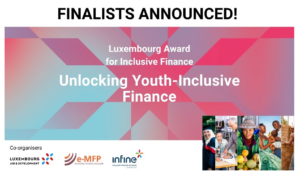
On 16 and 17 September 2026, the Selection Committee for the Luxembourg Award for Inclusive Finance 2026 (LAIF2026) on ‘Unlocking Youth-Inclusive Finance’ met and eventually selected the three finalists who will go on to compete for the €100,000 prize: Chancen International from Rwanda, Fundación Paraguaya, and iFarmer Ltd. from Bangladesh.
Since the process began early in the year, the Luxembourg Award for Inclusive Finance 2026 on ‘Unlocking Youth-Inclusive Finance’ has sought to highlight organisations active in financial inclusion that accompany young people as they navigate life’s key stages, helping them develop the skills, financial capabilities and opportunities needed to build prosperous futures. This means understanding the different needs of young people, designing appropriate and responsible financial and non-financial services, finding effective ways to reach and engage them, and demonstrating how these approaches can contribute to meaningful outcomes in their lives.
Young people make up a large and growing share of the population in many of the countries where financial inclusion organisations operate. Yet the transition from childhood to independent adulthood brings particular financial and economic challenges. Young people are more likely to have irregular or insecure incomes, limited assets and financial histories, and less experience of formal financial services. They may face legal or regulatory restrictions on opening and operating accounts, while products designed for older adults can be poorly suited to their needs. At the same time, young people must navigate critical transitions in education, employment, entrepreneurship and family life that can shape their economic prospects for decades.
Financial inclusion can play an important role in helping young people navigate these transitions. Appropriate savings, credit, payments, insurance and other financial services can help them manage emergencies, invest in education and skills, enter employment, start or grow a business, and begin to build assets. But access to finance alone is seldom sufficient. Financial education, entrepreneurship support, mentoring and coaching, appropriate delivery channels and partnerships with organisations that understand and reach young people can be equally important in turning financial access into meaningful opportunities.
The LAIF2026 application process began in March, with Round 1 receiving a near-record 95 applications from 43 countries. The breadth of the field reflected the diversity of the youth-inclusive finance sector itself. Applicants included 44 microfinance institutions, 18 fintechs, 12 non-financial NGOs, seven banks, five cooperatives or credit unions, an insurance company, and other private-sector and specialist organisations. These organisations’ initiatives were diverse, representing a wide range of approaches for helping young people navigate life’s key stages.
After a first assessment against the Award’s eligibility and evaluation criteria, 35 organisations were invited to participate in the more comprehensive Round 2. The Award evaluation team then assessed these applications against a detailed evaluation framework covering applicants’ understanding of the challenges facing young people, their youth-inclusive approach, products, services and outreach, marketing, delivery and partnerships, responsible practices and protection, monitoring and outcomes, lessons learned, and future plans. Following this assessment, 18 applicants from 15 countries were forwarded to an expert Selection Committee, including representatives of the Luxembourg Government and members of e-MFP and the Inclusive Finance Network Luxembourg (InFiNe.lu). The Selection Committee met over two days and chose ten semi-finalists, and among them the three finalists:
- Chancen International is a nonprofit microfinance organisation established in 2018 and operating in Rwanda, Kenya, South Africa and Ghana. It serves underserved young people aged 18-35, particularly low-income and rural learners and young women who face barriers to financing post-secondary education. Its youth-inclusive approach centres on Income Share Agreements, which finance employment-aligned education without upfront payment, collateral or guarantors. Repayment begins only once graduates earn above a defined income threshold, varies with income and ends after a fixed term. Chancen works with selected education and training institutions and complements financing with financial literacy, career readiness, wellbeing support and links to employment opportunities. The approach is designed to enable young people excluded from conventional education finance to access tertiary education and training and support their subsequent transition into employment.
- Fundación Paraguaya is a nonprofit microfinance organisation established in Paraguay in 1985, serving low-income and underserved communities, particularly women and rural households. Its youth-inclusive approach targets young people aged 15-30, with particular attention to low-income young women and rural youth. The approach combines microloans, education finance and village banking with financial and digital literacy, entrepreneurship, vocational training and coaching. A central element is the Poverty Stoplight, a multidimensional self-assessment methodology through which participants identify their own deprivations and work with mentors to address them, linking financial services with wider social and economic needs. Youth-specific services include student loans, youth committees, loans for young people without established credit histories, student-run enterprises and agricultural-school training. Together, these services support young people’s transitions into further education, employment, entrepreneurship and greater economic independence.
- iFarmer Ltd. is an agricultural fintech established in Bangladesh in 2019 and operating across 42 districts. It primarily serves rural smallholder farmers, with young farmers under 30 representing a substantial share of its client base and including both young men and women. Its youth-inclusive approach combines formal working-capital finance with agricultural inputs, advisory services, market access and support for climate-smart farming. Its “phygital” model combines physical iFarmer Centers and community-based support with digital tools, including Folon for agricultural advisory services, Sofol for financial profiles and loan management, and Krishop for agricultural inputs. Farmer data, transaction histories and field verification help connect young farmers without conventional collateral or credit histories to partner financial institutions. The approach is designed to help young people develop agriculture as a more productive, commercially viable and resilient livelihood.
The Award organising team would also like to congratulate the other seven semi-finalists: Agro Consortium from Uganda; Al-Amal Microfinance Bank from Yemen; Caja Municipal de Ahorro y Crédito Cusco from Peru, Opportunity Bank Uganda (OBUL); Success for People from Ghana, VisionFund MicroFinance Institution in Ethiopia; and World Relief from Rwanda.
The three finalists will now be evaluated by the Award’s High Jury, which will select and then announce the winner at a ceremony organised by InFiNe on 12 November 2026, held at the European Investment Bank during Inclusive Finance 26 (IF26). The winner will receive the €100,000 Award, with €10,000 awarded to each of the two runners-up.
Recognition through the Award extends beyond the prize itself. All ten semi-finalists will be profiled in e-MFP’s annual Award publication, launched during IF26, as well as through press coverage and the award website, managed by InFiNe. Drawing on the applications and the evaluation process, the publication will showcase the different models and approaches represented by the semi-finalists and identify lessons and factors for success that can inform organisations seeking to make financial inclusion work better for young people.
For any question, feel free to contact:
e-MFP
T. +352 26 27 13 / Award@e-mfp.eu / www.e-mfp.eu
Loretta Marie Perera, rperera@e-mfp.eu, +352 661871214
InFiNe (Inclusive Finance Network Luxembourg) a.s.b.l
T. +352 28 37 15 09 / contact@infine.lu / www.infine.lu
Dounia Qamel: dounia.qamel@infine.lu